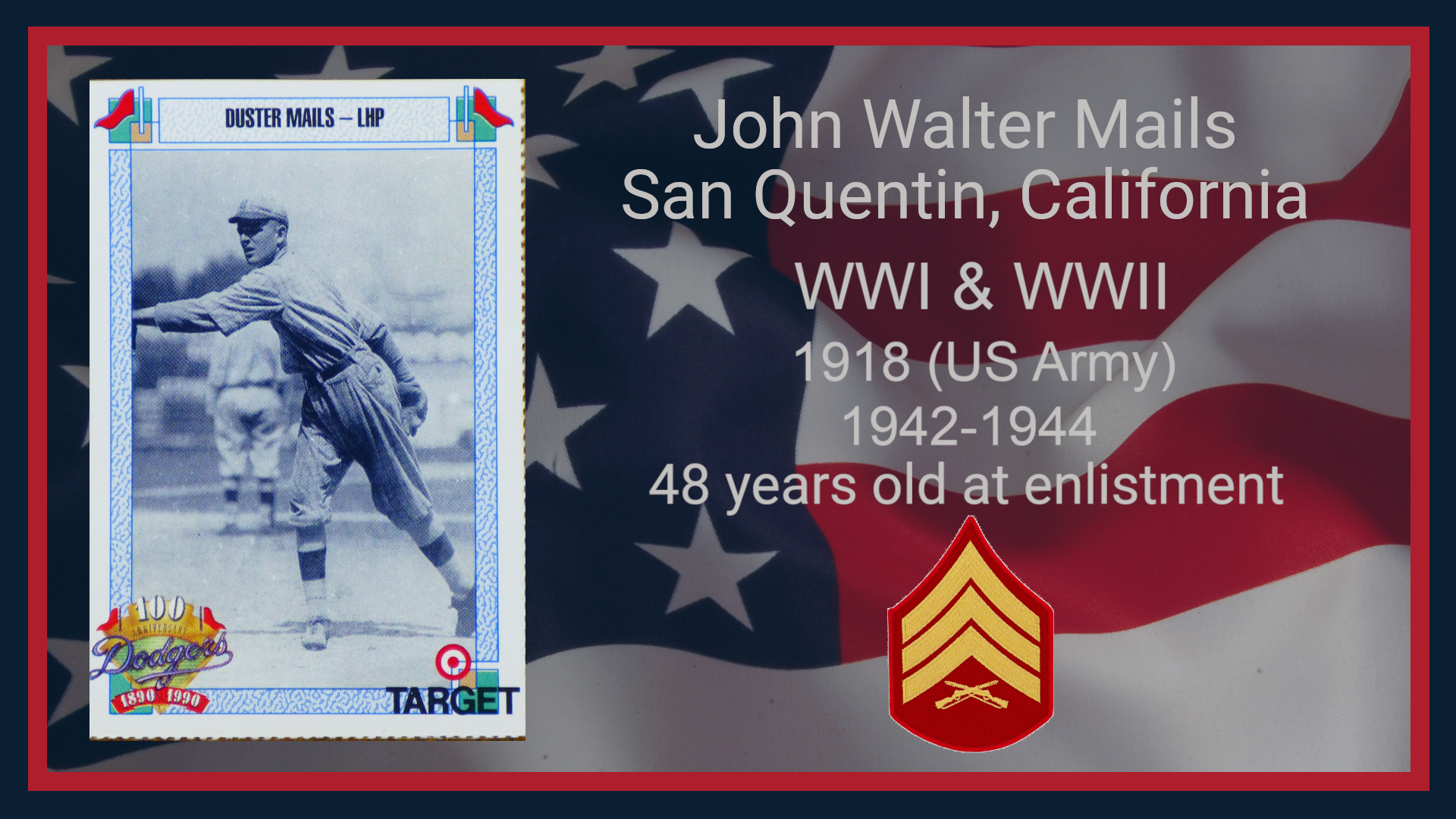
Duster Mails
Marine Corps Service
John Walter “Duster” Mails was one of the uncommon professional ballplayers—like fellow Marines and Major Leaguers Mike Cantwell and Joe Berry Jr.—whose military service touched both World Wars. Mails’s two periods of service came in different branches and at dramatically different stages of his life.
During World War I, Mails served in the United States Army at Camp Lewis, Washington. Assigned to the 363rd Infantry Regiment of the 91st Division, he also pitched for the camp baseball team. In May 1918, the Army released him for essential war-industry work as a shipfitter in Seattle. Mails initially resisted playing for his shipyard team because he feared being regarded as a slacker, but eventually pitched in the city’s highly competitive wartime league. His 363rd Infantry assignment later fought overseas, while Mails’s documented wartime work and baseball remained in Washington.
Nearly a quarter-century later, Mails answered the call again. In 1942, at age 48, he earned the title of United States Marine. As Sergeant Mails, he worked from the Marine recruiting office in San Francisco and traveled through Northern California addressing schools, civic organizations, and potential recruits. A contemporary account preserved by the Newman Historical Society records his 1944 appearance before students at Orestimba High School and the Newman Exchange Club.
Mails was also associated with the 13th Replacement Depot in Hawaii. He was discharged from the Marine Corps on October 31, 1944, then trained with the American Red Cross and returned overseas as a Red Cross representative in 1945. The arc was extraordinary: an Army infantryman and shipyard worker in the First World War, then a Marine sergeant and wartime ambassador in the Second.
Baseball Career
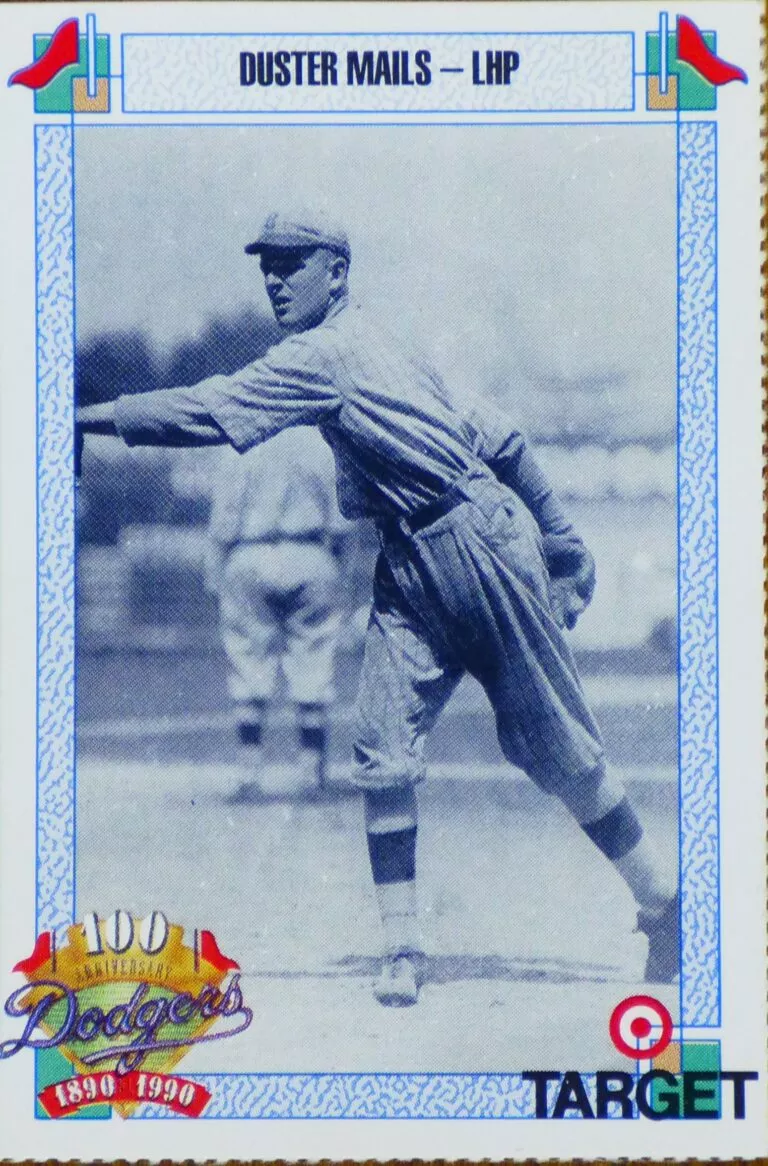
Mails was born near San Quentin, California, on October 1, 1894. The left-hander reached the majors with the Brooklyn Robins on September 28, 1915. His nickname grew from his early wildness: Mails later explained that he did not intentionally brush hitters back—he simply could not always make the ball go where he wanted. Never lacking confidence, he also promoted himself as “The Great Mails.”
His defining season came in 1920. Cleveland acquired him from Sacramento late in the pennant race, and Mails went 7–0 as the Indians held off the Chicago White Sox. On September 24, he defeated Hall of Famer and World War I Navy veteran Red Faber, 2–0, amid the unfolding scandal surrounding the 1919 White Sox.
Mails was even better in the World Series against his former Brooklyn club. He threw 15⅔ scoreless innings in two appearances. With Cleveland leading the best-of-nine Series four games to two, Mails pitched a three-hit shutout in Game Six and defeated Sherry Smith, 1–0. Stan Coveleski completed the championship the following day, giving Cleveland its first World Series title.
Mails followed with a 14–8 record in 1921 but arm trouble and inconsistency limited his remaining Major League opportunities. He later appeared for the St. Louis Cardinals, making his final Major League appearance on April 29, 1926. Across parts of seven seasons, he went 32–25 with a 4.10 earned-run average in 104 games.
His larger professional career lasted far longer. Mails pitched extensively in the Pacific Coast League, where his talent, theatrical personality, and gift for publicity made him one of the circuit’s most recognizable figures. In the final victory of his playing career, he reportedly called his outfielders into the infield before striking out the last batter—a flourish perfectly suited to a pitcher who never objected to center stage.
Gallery
Later Life and Legacy
Mails converted his flair for promotion into a second baseball career. He worked in public relations for the San Francisco Seals and later joined the San Francisco Giants’ speakers bureau. He became especially associated with children’s promotions and claimed responsibility for bringing millions of young fans to the ballpark.
Mails remained a popular banquet speaker and storyteller. His standard introduction reportedly came with a handshake and the announcement, “Congratulations, you just shook the hand of the Great Walter Mails.” He continued working with the Giants until 1972 and died at the Fort Miley Veterans Hospital in San Francisco on July 5, 1974, at age 79.
His life connected several distinct chapters of American history: Army service and Seattle’s shipyard league during World War I, Cleveland’s first championship, decades of West Coast baseball, Marine recruiting duty during World War II, and the arrival of Major League Baseball in San Francisco.
Sources and Further Reading
- Newman Historical Society, “Duster Mails: Baseball Hero Visits Newman”
- Lookout Landing, “War, Pandemic, and Seattle Baseball in 1918”
- Lookout Landing, “War, Pandemic, and Seattle Baseball in 1918: Part 3”
- Society for American Baseball Research, September 24, 1920 game account
- Society for American Baseball Research, Red Faber biography and Navy service
- Society for American Baseball Research, October 11, 1920 World Series game account
- Baseball History Daily, “A Colorful Critter”
- Major League Baseball, Duster Mails career record
- Baseball-Reference, Duster Mails Major League record
- Wikipedia, Duster Mails
- Find a Grave, John Walter Mails memorial