Ted Lyons
Marine Corps Service
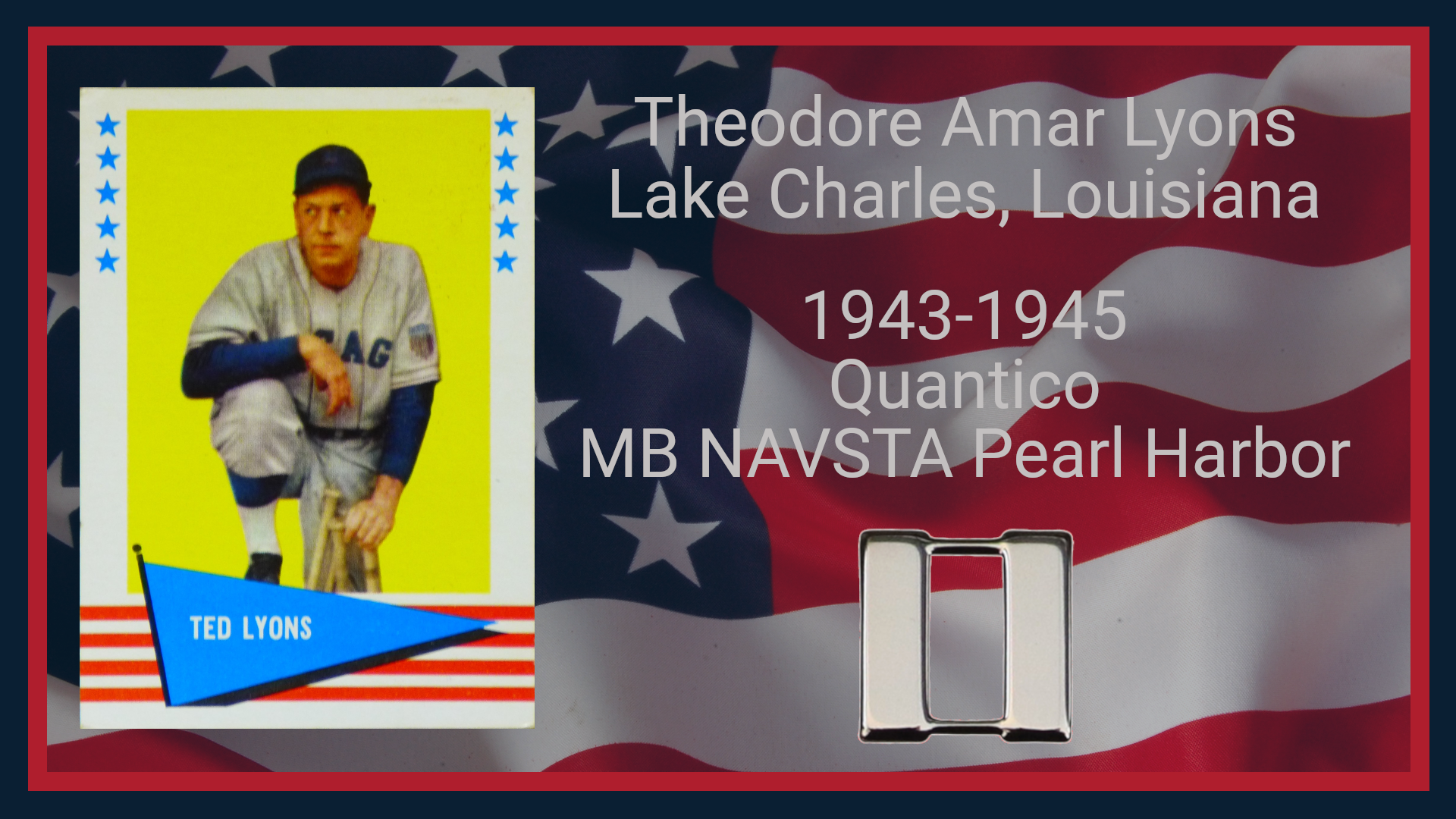
Theodore Amar “Ted” Lyons earned the title of United States Marine after completing the Reserve Officers’ Class at Quantico, Virginia, on April 7, 1943. Already 42 and beyond draft age, the longtime Chicago White Sox pitcher had volunteered following one of the finest seasons of his career. Commissioned a second lieutenant, he reported immediately to Navy Pier in Chicago, where the military trained aviation personnel.
Lyons led a Marine detachment in a drill demonstration at Comiskey Park in June 1943 and transferred to Camp Pendleton that August. He pitched for the Camp Pendleton Marines and faced fellow Major Leaguer Red Ruffing in the West Coast service championship. Promoted to captain, Lyons deployed to the Pacific in April 1944. At his request, White Sox manager Jimmy Dykes sent two dozen White Sox caps to the fighter pilots in Lyons’s sector, along with Lyons’s familiar number 16 jersey.
In Hawaii, Lyons served as a physical-fitness instructor and managed and pitched for Marine aviation teams. He also participated in service all-star competition featuring many of baseball’s greatest names. After facing Joe DiMaggio again, Lyons joked that he had left the country to get away from him only to find him waiting in the Pacific. Lyons became friends with fellow Marine Ted Williams and watched Navy star Stan Musial, whose unusual batting stance he compared to a youngster peeking around a corner for the police.
Lyons completed his Marine service as a captain late in 1945. Rather than accept the White Sox coaching position offered to him, the 45-year-old chose to return as an active pitcher.
Baseball Career
Lyons was born in Lake Charles, Louisiana, on December 28, 1900. He starred in baseball and football at Baylor University and initially intended to study law. After signing with the White Sox in 1923, he bypassed the minor leagues entirely. The first Major League game he ever saw was also his Major League debut: on July 2, 1923, he entered against the St. Louis Browns and retired all three batters he faced.
Lyons soon became the anchor of the Chicago staff. He led the American League in victories in 1925 and 1927, won 20 or more games three times, and threw a no-hitter against the Boston Red Sox at Fenway Park on August 21, 1926. When arm and back trouble diminished his fastball, he reinvented himself with curves, changes of speed, and a knuckleball.
Beginning in 1939, manager Jimmy Dykes generally reserved Lyons for Sunday games. The arrangement kept the aging pitcher rested and took advantage of his drawing power, earning him the nickname “Sunday Teddy.” He responded with a 14–6 record and his first All-Star selection. In 1942, at age 41, Lyons completed all 20 of his starts, went 14–6, and led the American League with a 2.10 earned-run average before stepping away for Marine service.
His 1946 return produced one final milestone. On April 28, Lyons pitched a complete game for his 260th victory. It proved to be his last win, although his run of complete games reached 28 consecutive starts dating to 1941. Five starts into the season, the White Sox selected him to replace Dykes as manager, ending Lyons’s playing career on May 19.
Lyons spent all 21 of his Major League seasons with Chicago and remains the White Sox franchise leader with 260 victories. His career included 594 games, 484 starts, 356 complete games, 27 shutouts, and 4,161 innings pitched. Yankees manager Joe McCarthy famously believed that Lyons could have won more than 400 games had he pitched for New York.
Gallery
Later Life and Legacy
Lyons managed the White Sox through the 1948 season, then served as pitching coach for the Detroit Tigers and Brooklyn Dodgers. He later returned to the White Sox organization as a scout. His ability to teach pitchers reflected the same adaptability that had allowed him to remain effective after losing his fastball.
The Baseball Writers’ Association of America elected Lyons to the National Baseball Hall of Fame in 1955. After retiring from professional baseball, he returned to Louisiana and helped his sister operate the family rice farm. Lyons died in Sulphur, Louisiana, on July 25, 1986, at age 85. The White Sox retired his number 16, commemorating a career spent entirely in their uniform.
Sources and Further Reading
- National Baseball Hall of Fame, Ted Lyons
- Society for American Baseball Research, Ted Lyons biography
- Baseball in Wartime, Ted Lyons military biography
- Baseball-Reference, Ted Lyons Major League record
- Major League Baseball, Ted Lyons career record
- Wikipedia, Ted Lyons
- Find a Grave, Ted Lyons memorial