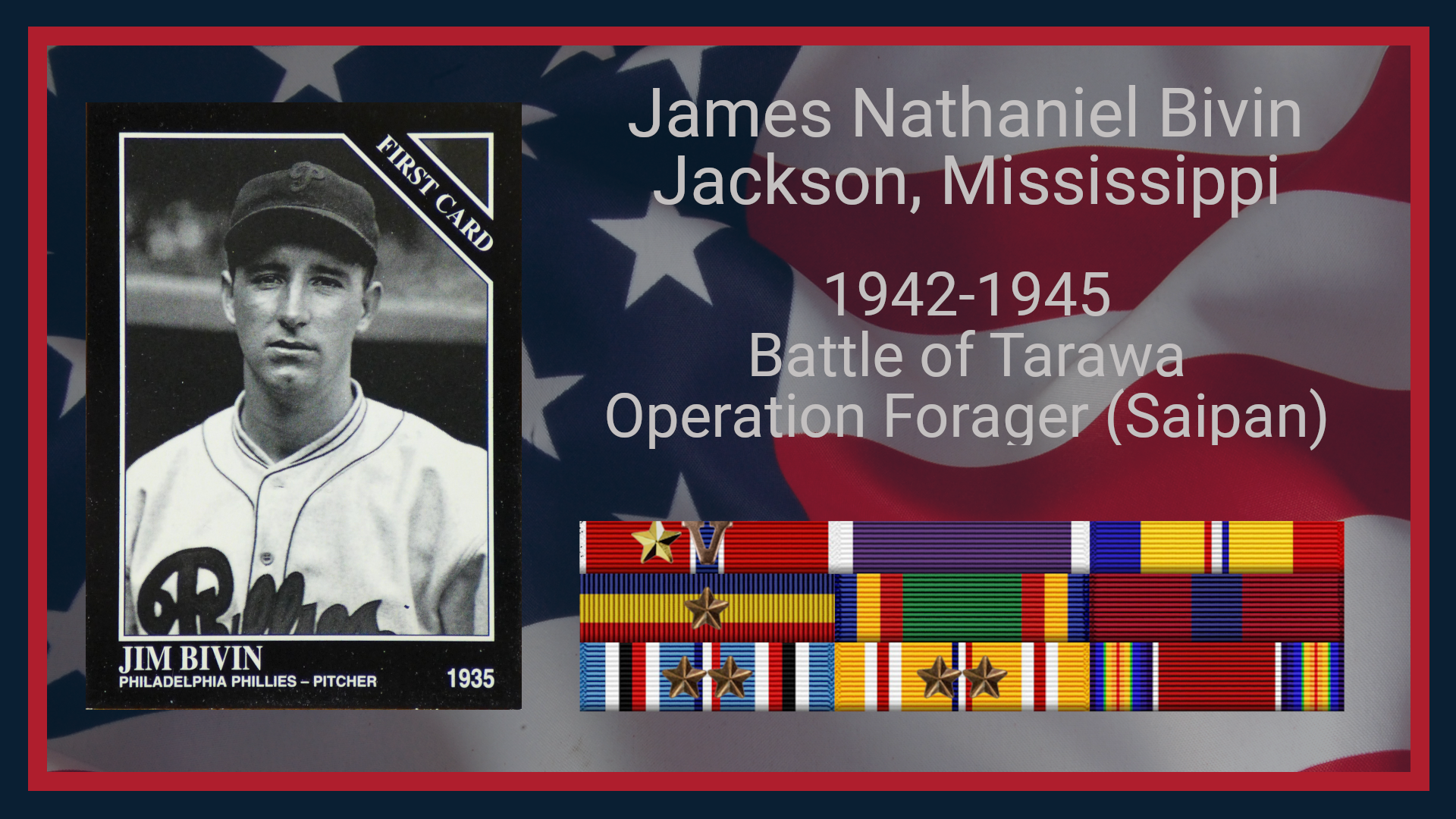
Jim Bivin
Marine Corps Service
Bivin entered the Marine Corps in July 1942, interrupting his season with the Richmond Colts at age 32. After training, he served in a quartermaster unit of the 2nd Marine Division, helping move supplies from landing beaches toward Marines fighting at the front.
He landed at Tarawa in November 1943. The fighting on Betio exposed the landing force to concentrated Japanese machine-gun, mortar, and artillery fire as Marines struggled across the reef and beaches. Bivin later compared the incoming bullets to line drives through a pitcher’s box—with the critical difference that the bullets could not be seen coming.
After Tarawa, the 2nd Marine Division returned to Hawaii to rebuild and prepare for the Marianas. Available accounts place Bivin at Saipan in June 1944 during Operation Forager, where the division fought through fortified positions and sustained resistance before the island was secured.
Bivin returned to the United States in late 1945 and received an honorable discharge. Biographical accounts credit him with two Bronze Star Medals and a Purple Heart. His decorations and his own description of Tarawa establish that his wartime service extended far beyond the military baseball assignments given to many professional players.
Baseball Career
Bivin made his Major League debut with the Philadelphia Phillies on April 16, 1935. He appeared in 47 games that season, including 14 starts, and finished with a 2–9 record, one save, and 54 strikeouts.
His brief Major League career intersected twice with baseball history. On May 24, Bivin pitched a scoreless eighth inning against Cincinnati in the first night game in Major League history. Six days later, he started the opening game of a Memorial Day doubleheader against the Boston Braves at Baker Bowl. In the first inning, Babe Ruth grounded one of Bivin’s pitches to first baseman Dolph Camilli. Ruth left the game after the inning and never played again, making Bivin the final Major League pitcher he faced.
Bivin made his final Major League appearance on September 29, 1935, but continued pitching in the minors for many years. He threw no-hitters for Galveston in 1937 and Richmond in 1940, won 20 games for Richmond in 1941, and resumed his career after the war. Across his minor-league career, he compiled a 163–133 record.
Later Life and Legacy
Bivin became a successful player-manager after the war. He guided the Greenwood Dodgers to the Cotton States League championship in 1947 and later managed at Danville, Pueblo, and Lancaster. Players and fellow servicemen knew him as “Gentleman Jim,” a reflection of the respectful manner he carried through both careers.
After leaving professional baseball, Bivin became a certified nurse and worked at the Colorado State Hospital in Pueblo until his retirement. He died in Pueblo on November 7, 1982. His place in baseball history rests on far more than one famous groundout: he was a durable minor-league pitcher, a championship manager, a medical professional, and a decorated Marine who served under fire in the Pacific.
Sources and further reading
- United States Marine Corps — History of the 2nd Marine Division
- United States Marine Corps — History of the 2nd Marine Regiment
- Society for American Baseball Research — Jim Bivin biography
- Society for American Baseball Research — Babe Ruth’s final Major League game
- Baseball Reference — Jim Bivin Major League statistics